Summary:
-
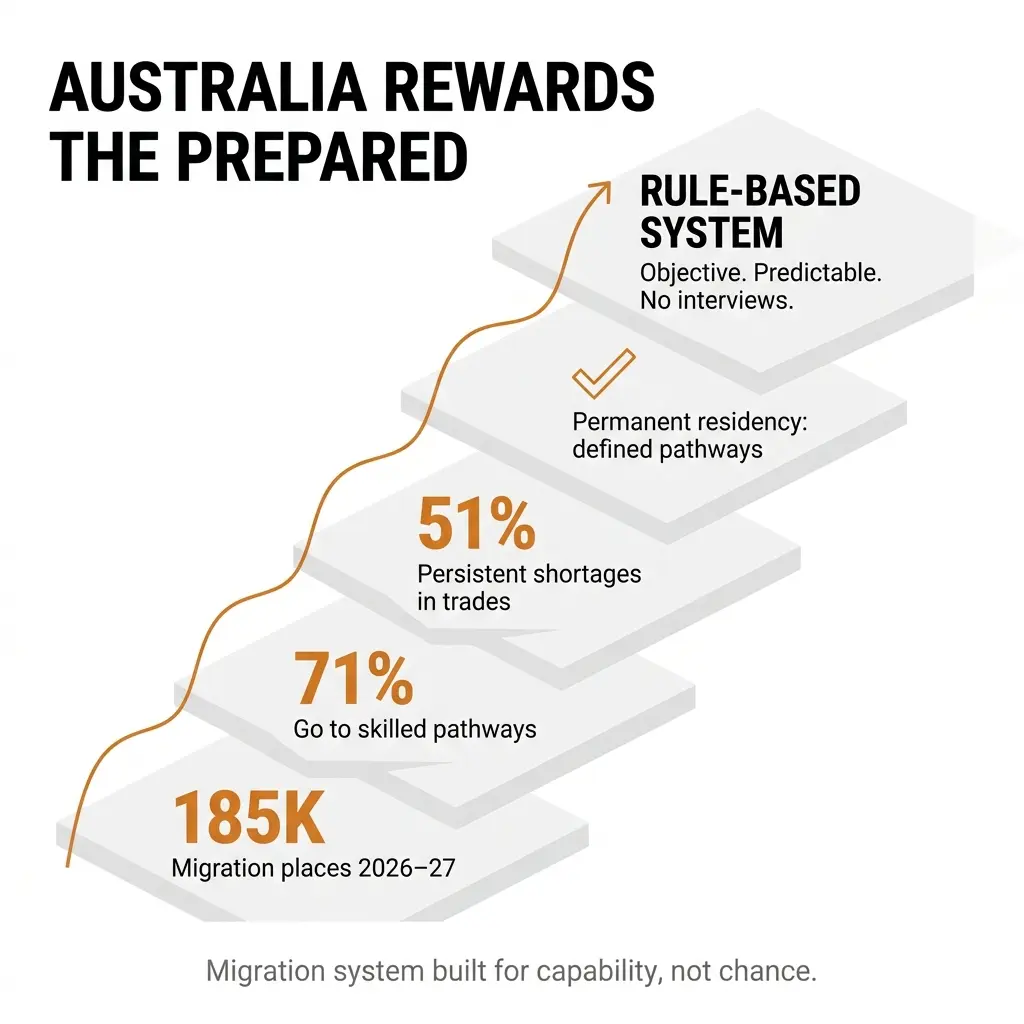
Australia's 2026 - 27 Migration Programme reserves over 71 per cent of its 185,000 places for skilled pathways.
-
Permanent residency is a defined, durable outcome, not a theoretical promise, through Subclass 189, 190, 186, and 491 routes.
-
Trades, healthcare, and technology face persistent labour shortages that the country openly acknowledges.
-
The points-based system awards scores across measurable categories, which means you can assess your own competitiveness before committing a single dollar.
-
Australia's multicultural foundation and geographic position make professional integration and global opportunity more accessible than in most comparable destinations.
I arrived in Australia with nothing settled. No guaranteed job, no local network, no clear picture of how the system would treat me. I built a life here through a defined process, and I now spend my days helping other capable people do the same.
Over the years I have started to see a pattern in who thrives here. The people who do well are rarely running away from somewhere. They are building something, and they treat the move as a considered investment in the life ahead rather than a flight from the one behind.
Australia rewards that kind of person. Let me explain why, from the operating reality rather than the brochure.
Why Does the Quality of Life in Australia Stand Out?
Most destinations promise a good life. What matters is whether that life sits within reach of a middle-income earner, or whether it stays behind glass for everyone except the wealthy.
In Australia, the ordinary version of the good life is real. The average household net-adjusted disposable income sits above the OECD average, and the country leads global quality of life across income, jobs, health, and environment.
Healthcare deserves particular attention, because it is the cost that quietly reshapes a family's finances elsewhere. Medicare is funded through a two per cent levy on taxable income, which means quality care stays affordable at a normal salary, and life expectancy runs about three years above the OECD average.
Education follows the same pattern. Strong public schooling and high completion rates give your children a genuine start without a private-school price tag attached to it.
Key Point: Australia's quality of life is not a premium reserved for the wealthy, it is genuinely accessible at a middle income, across health, education, and environment.
How Is Australia's Migration System Designed for Skilled Professionals?
Australia does not treat skilled migration as a favour it reluctantly grants. It treats it as a strategy.
The 2026 - 27 permanent Migration Programme holds 185,000 places, and more than 71 per cent of those go to skilled pathways. That is a country deliberately selecting qualified professionals and tradespeople.
The mechanisms match the intent. You have the points-tested independent route, employer-sponsored pathways, state-nominated options, and the National Innovation Visa for exceptional talent. The government has also invested to deliver faster skills assessments for trades workers, which reduces the bureaucratic friction that used to stall qualified people at the door.
Key Point: Australia's migration architecture is not passive, it actively competes for qualified people through multiple, structured skilled pathways.
What Are the Permanent Residency Pathways in Australia?
Some destinations dangle permanence and then keep moving the finish line. Here, the pathways are defined and durable.
The Subclass 189, 190, and 186 routes remain open, and regional options such as the Subclass 491 lead to permanent residency through the Subclass 191 after three years of regional living. Permanent residency gives you indefinite residence, Medicare access, the right to sponsor eligible relatives, and a clear road to citizenship. There are employer-sponsored pathways to permanent residency, I will explore them in my next post.
I want to be honest about what this requires. Permanent residency here is a realistic outcome for the prepared applicant, not a theoretical promise handed to everyone who applies.
Key Point: Permanent residency in Australia is a clearly defined destination, the routes are real, the conditions are transparent, and the prepared applicant can plan for it with confidence.
Which Skills Does Australia's Labour Market Actually Need?
Demand is not a marketing line in Australia. It shows up in the numbers.
According to Jobs and Skills Australia, 51 per cent of all persistent shortages sit in Technicians and Trades Workers, with a vacancy fill rate of just 54.3 per cent, making trades the hardest roles to fill nationally.
Healthcare carries the same weight, with registered nurses and general practitioners among the most undersupplied roles for five consecutive years. Technology roles keep expanding too, with the government projecting over 58,000 new positions in cybersecurity and software engineering by 2028.
If your skills sit in one of these sectors, you are not competing for scraps. You are answering a shortage the country openly acknowledges.
Key Point: Australia's labour shortages in trades, healthcare, and technology are documented and persistent, qualified applicants in these fields are not filling a gap, they are answering a call.
How Does Australia's Points-Based System Work?
This is the part I find most people underestimate before they arrive, and value most once they understand it.
Australia runs a rule-based, objective system. Points get awarded across measurable categories: age, English proficiency (up to 20 points), qualifications, and skilled work experience. There is no subjective interview deciding your fate on a mood.
The same fixedness that frustrates someone hoping for a shortcut becomes reassurance for someone who has done the work. You can assess your own competitiveness against a published threshold before you commit a single dollar, which means you can forecast your outcome rather than gamble on it.
For a prepared person, that predictability is one of the strongest reasons to trust the destination with your future.
Key Point: The objectivity of Australia's points system is its greatest advantage, because the criteria are published and measurable, a prepared applicant can self-assess before spending anything.
What Makes Australia's Geographic and Cultural Position Unique?
Australia sits close to Asia whilst running on Western legal and institutional frameworks. That combination gives you commercial proximity to the fastest-growing region on earth alongside the stability and rule of law you would expect from an established democracy.
Integration is genuinely easier here because migration is part of the national story rather than an exception to it. Almost two-thirds of permanent skilled migrants arrive through points-tested visas that assess contribution rather than country of origin.
You are not arriving as an outsider asking permission to belong. You are joining a place already built by people who did what you are about to do.
Key Point: Australia's combination of Asian-Pacific proximity and Western institutional stability is rare, and its multicultural foundation makes professional integration meaningfully easier than in most comparable destinations.
What This All Adds Up To
Australia rewards intentionality. It rewards qualifications, financial readiness, and the willingness to treat a move as architecture rather than escape.
The quality of life is attainable on a normal income. The migration system is built to select people like you. The pathways to permanence are real, the labour market needs your skills, and the rules are objective enough that you can plan around them with confidence.
If you are weighing this seriously, the most useful next step is an honest assessment of where you actually stand. At MigrationHotline, that is what I offer: a clear reading of your options, including the hard truths, so you can decide with your eyes open. I highly recommend you start there before you commit to anything, because the prepared applicant is the one this country rewards, and preparation begins with knowing exactly where you stand.
Frequently Asked Questions
Who does Australia's skilled migration system favour?
Australia's system favours applicants with assessed qualifications, strong English proficiency, relevant work experience in a shortage occupation, and financial readiness. It is designed for people who are building something, not escaping something, because the system scores preparation, not desperation.
How long does it take to get permanent residency in Australia?
It depends on the pathway. Independent skilled visas (Subclass 189) can be granted within 6 - 12 months for high-scoring applicants. Regional pathways (Subclass 491 leading to 191) require three years of regional living before permanent residency is accessible. Employer-sponsored routes (Subclass 186) vary by stream.
What is the pass mark for Australian skilled migration?
The minimum points threshold is 65, but in practice, competitive applicants in popular occupations need significantly more, often 80 to 95 points or above, because invitations are issued to the highest-scoring candidates in each round.
Does Australia have a shortage of skilled workers?
Yes, and it is documented. According to Jobs and Skills Australia, trades roles have a vacancy fill rate of just 54.3 per cent. Healthcare and technology sectors face persistent multi-year shortages. The government openly acknowledges and plans its Migration Programme around these gaps.
Can I bring my family if I get permanent residency in Australia?
Generally speaking, your family members, spouse and children, can be included in your visa application. Permanent residents have the right to sponsor eligible relatives for certain visa categories. The specific pathways depend on the relationship and the family member's circumstances, an assessment of your individual situation is always the most reliable starting point.
Is Medicare available to skilled migrants?
Medicare is available to permanent residents and citizens. Temporary visa holders may have access through reciprocal healthcare agreements depending on their country of origin. For permanent residents, Medicare is funded through a two per cent levy on taxable income, making quality healthcare affordable at a normal salary.
What is the National Innovation Visa in Australia?
The National Innovation Visa is designed for individuals with exceptional talent or achievement in their field. It provides an alternative pathway outside the standard points-tested system, aimed at attracting globally significant professionals across technology, science, business, arts, and sport.
How do I know if my skills qualify for Australian migration? The most reliable way is a professional assessment against the relevant skills assessing authority for your occupation, cross-referenced with the current skilled occupation lists and your personal points score. I highly recommend starting with an honest assessment of where you actually stand before committing to any pathway.
Key Takeaways
Australia's quality of life, across health, education, income, and environment, is genuinely accessible at a middle income, not reserved for the wealthy.
The 2026 - 27 Migration Programme allocates over 71 per cent of 185,000 places to skilled pathways, reflecting a deliberate national strategy to attract qualified professionals.
Permanent residency is a real, defined outcome through multiple routes (Subclass 189, 190, 186, 491/191), not a theoretical promise.
Australia faces documented, persistent shortages in trades, healthcare, and technology, qualified applicants in these sectors are answering a national need, not competing for scarce positions.
The points-based system is objective and measurable, which means a prepared applicant can self-assess competitiveness before spending anything.
Australia's geographic position, close to Asia, grounded in Western institutions, offers a rare combination of commercial opportunity and institutional stability.
Preparation is the single most important variable, the applicants this country rewards are those who have done the work before they arrive at the door.