Regional employers do not have a recruitment problem. They have a structural labour shortage, and the standard skilled migration programme was not designed to solve it. If you have spent the past year advertising roles that stay empty, watching candidates accept city salaries you cannot match, and hearing the word "shortage" used as though it explains something rather than just naming it, a Designated Area Migration Agreement may be the framework your business has been waiting for.
That said, the employers who benefit from a DAMA are the ones who understand the mechanics before they build their case, not the ones who treat it as a shortcut. I want to walk you through what this framework genuinely offers, and what it requires of you in return.
The Two-Tier Structure That Most People Miss
A DAMA is not a single agreement. It operates through two tiers, and understanding the difference matters enormously for how you plan.
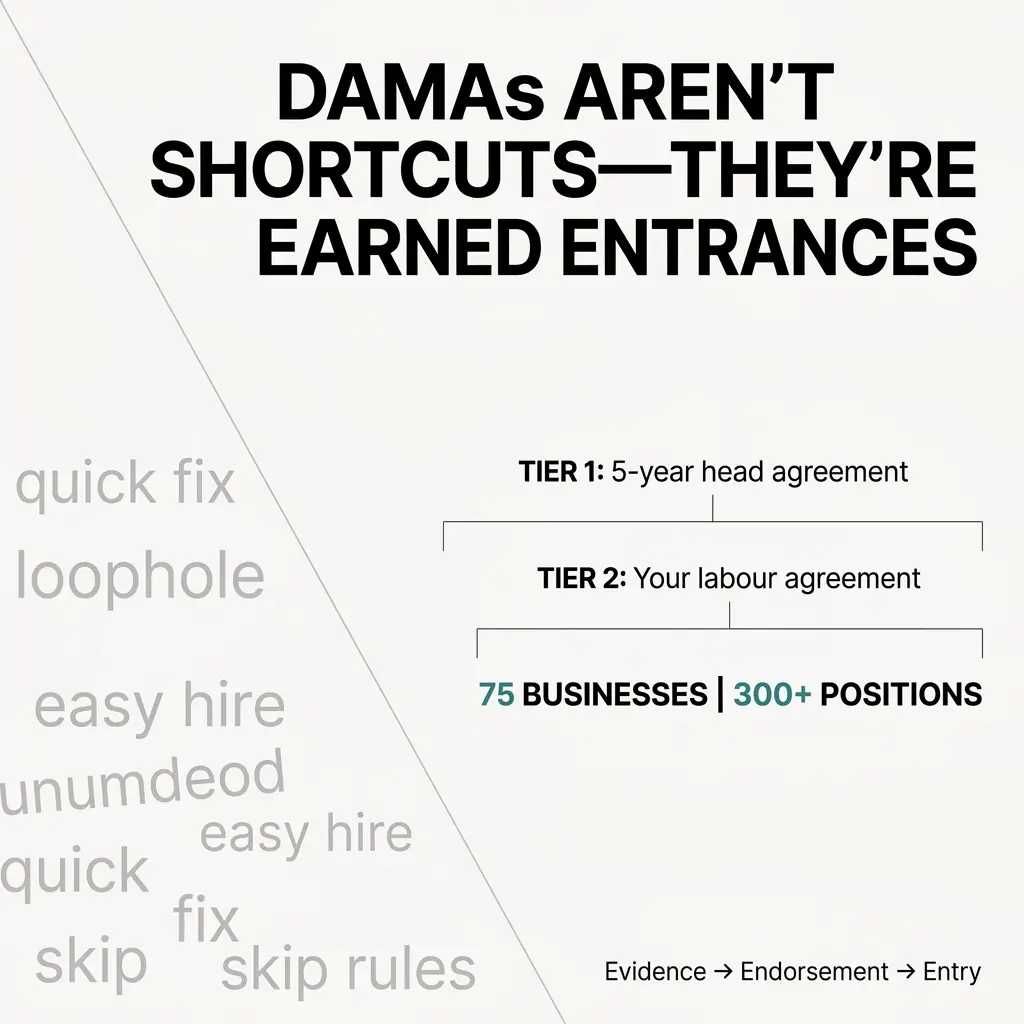
The first tier is a five-year head agreement between the Australian Government and a Designated Area Representative, usually a regional development body or local authority. That head agreement sets the occupation lists and the concessions available for the region. The second tier is your own individual labour agreement, negotiated between the government and you as an endorsed employer operating inside that region.
This structure gives you something standard employer sponsorship does not, which is five-year stability for workforce planning. You are building a long-term staffing strategy rather than fighting one-off applications each time a role opens.
Where Australia Currently Has DAMAs
There are 13 active DAMAs across Australia, each tailored to the labour needs of its region. They span the Northern Territory, South Australia, Western Australia, Queensland, Victoria, and New South Wales, and the occupation lists differ sharply between them.
The Northern Territory leads with 325 eligible occupations, Western Australia follows with 310 positions across its regions, and South Australia covers over 280 skilled and semi-skilled roles. These lists reach well beyond standard skilled migration programmes, including Skill Level 4 semi-skilled roles and even non-ANZSCO coded positions such as Civil Construction Supervisor and Hydrogen Process Operator.
If your hardest-to-fill role has never appeared on a standard occupation list, this is the reason a DAMA becomes worth examining.
The Concessions, and What You Trade for Them
The concessions are the part everyone talks about, and they are genuinely useful when your region and occupation qualify.
Age. Some regions extend the age limit to 55 for permanent residence, compared with the standard 45.
English. For specified semi-skilled roles, requirements drop as low as IELTS 4.5 overall with 4.0 in each band.
Salary. A concession of up to 10 per cent on the income threshold applies.
Work experience. Reduced experience requirements apply for certain occupations.
These concessions are earned entrances into a structured framework. You reach them by proving your case, which brings us to the part that decides whether an application holds together or collapses.
Labour Market Testing Is Non-Negotiable
A DAMA rewards employers who can demonstrate the shortage is real. Before you access a labour agreement, you must show genuine attempts to recruit Australian citizens and permanent residents first, typically through advertising for 28 consecutive days in appropriate channels.
⚠️ Labour market testing is not paperwork you tidy up at the end. It is evidence you gather at the start, and weak testing is one of the most common reasons a promising application falls apart.
I have watched applications that looked strong on paper come undone for want of evidence that could have been assembled early and simply was not. That experience taught me to front-load the unglamorous groundwork, because the same rigour that unlocks access is what keeps the workforce plan standing across the full life of the agreement.
The Visas That Carry the Plan
A DAMA connects to three main visa subclasses, and each plays a distinct role in your staffing timeline.
Subclass 482 (Skills in Demand) covers the temporary work stage, bringing the worker in under your labour agreement.
Subclass 494 (Skilled Employer Sponsored Regional) supports regional employment with a defined transition ahead.
Subclass 186 (Employer Nominated Scheme) is the permanent destination for many pathways.
The pathways to permanent residence are increasingly clear. South Australia now allows a transition from 482 to permanent 186 in just two years, reduced from three. Western Australia requires two years in Regional WA before ENS 186 eligibility, and subclass 494 holders can move to subclass 191 after three years of regional employment.
Why the Permanence Matters for Retention
The workforce stability is the quieter benefit, and for many regional operators it is the one that matters most over time. Workers under a DAMA are required to live and work in the designated area, and their permanent residence eligibility is tied to that regional employment.
That structure lowers turnover in a meaningful way. When a worker has a fair salary and a clear route to permanent residence for their family, they have every reason to stay, which gives you a settled and committed team rather than a revolving door.
The Reframe Worth Holding Onto
A DAMA is best understood as a legitimate long-term workforce planning framework for regions facing chronic shortages. The concessions on occupations, salary, English, and age are not a relaxation of standards handed out on request. They are earned entrances, opened by employers who build genuine evidence and get the two-tier structure right from the outset.
The Great South Coast DAMA offers a grounded illustration. It has facilitated agreements with 75 businesses in the region, opening over 300 positions that local recruitment could not fill, across more than 120 occupations from accountants and chefs to plumbers and nurses. That is what the framework looks like when the groundwork holds.
💡 The employers who benefit most treat evidence and structure as the entry price, not the afterthought. The rigour that unlocks access is the same rigour that keeps your plan intact for five years.
Getting the Structure Right from the Start
Compliance obligations run through the entire life of a labour agreement, from your endorsement by the Designated Area Representative to your record-keeping once workers arrive. Small unattended details early on tend to become the details that decide the whole outcome later, which is why I move that groundwork to the front of the process rather than leaving it to chance.
Here is what you are working with, in summary. A DAMA gives you access to broader occupation lists, meaningful concessions, and clear permanent pathways, backed by five years of planning stability. In return, you demonstrate a genuine local shortage, secure endorsement, and maintain your obligations throughout. Approached with that understanding, it becomes a navigable route rather than a maze.
If you are carrying roles you cannot fill and you want an honest reading of whether a DAMA fits your business, I highly recommend you seek proper advice before you commit to a path. I would rather tell you plainly that your case is not ready than watch you spend on an application that will not hold. When the evidence and the structure are sound, this framework works, and it is worth building carefully.