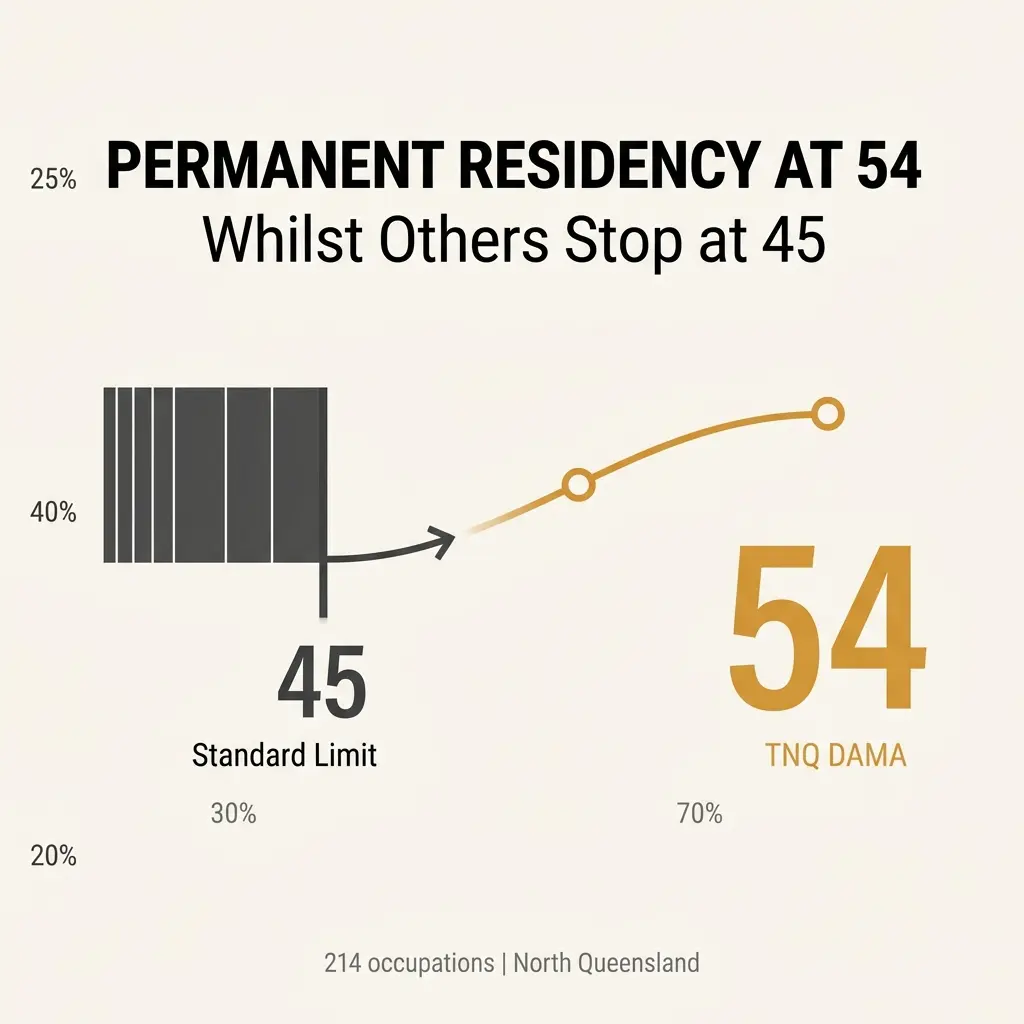
TL;DR: The Townsville North Queensland Designated Area Migration Agreement (TNQ DAMA) extends age limits to 55, lowers English requirements, and opens 214 occupations to permanent residency, making it one of Australia's most flexible regional migration pathways for skilled professionals who have been turned away by standard routes.
- Covers 214 occupations across Townsville and North-West Queensland
- Raises the permanent residency age limit from 45 to 50 or 55 for eligible roles
- Reduces the English requirement to IELTS 5.0 overall for most occupations
- Offers pathways to permanent residency via the ENS 186 and Skilled Regional 191 visas
- Endorsed 480 skilled workers in its first two years, with processing typically within five working days
If you have researched Australian migration for any length of time, you have probably run into the same walls that many of my clients describe. The age limit of 45 for permanent residency. The English test scores that feel disconnected from your actual working life. The occupation lists that seem to exclude your exact skill set. What I am starting to see in my practice is that many capable professionals give up at this point, which means they never discover the regional agreements that were designed for people exactly like them.
The Townsville North Queensland Designated Area Migration Agreement (TNQ DAMA) is one of those agreements, and it deserves far more attention than it currently receives. It covers 214 occupations across Townsville, Charters Towers, Burdekin, Hinchinbrook, Flinders, Richmond, McKinlay, Cloncurry, and Mount Isa, which makes it one of the most extensive agreements of its kind in Australia.
Why the Age Concession Matters More Than You Think
The standard cut-off of 45 for the employer-sponsored 186 visa has closed doors for thousands of experienced professionals, and in my experience these are often the applicants with the deepest expertise and the strongest employer demand. Under the TNQ DAMA, the age limit rises to 50 or even 55 for eligible occupations, depending on the role.
💡 If you are between 45 and 54 and you assumed permanent residency was behind you, that assumption is worth re-examining.
You built your career over two decades, which means you carry precisely the experience that regional employers struggle to find locally. The DAMA framework recognises that, and it adjusts the rules accordingly.
Key Point: The TNQ DAMA's age concession directly addresses one of the most common barriers for experienced professionals, because deep expertise should not expire at 45.
English Concessions That Reflect Working Reality
The standard English requirements exclude many practically skilled workers whose day-to-day communication is perfectly functional. Under the TNQ DAMA, eligible occupations require an IELTS overall score of 5.0, with no minimum per component for the temporary streams and a minimum of 4.0 per component for the permanent 186 pathway.
These concessions apply to high-demand roles such as cooks, chefs, aged carers, truck drivers, childcare workers, and motor mechanics. The reasoning behind this is grounded in workforce data, the region projects demand for over 20,000 new workers across North and North-West Queensland over the next five years, and the local workforce alone cannot meet that growth.
Key Point: Lower English thresholds under the TNQ DAMA are not a loophole, they reflect the genuine, data-backed workforce shortages that demand a more practical standard.
A Genuine Route to Permanent Residency
Many regional visa schemes offer temporary work with vague promises about the future, and I always tell my clients to look at the fine print before they relocate their lives. The TNQ DAMA holds up under that scrutiny. Many Skill Level 1 to 5 occupations under the agreement carry pathways to permanent residency through the ENS 186 or Skilled Regional 191 visas, which gives you strategic options for long-term settlement rather than a single fragile route.
The track record supports this. In its first two years, the agreement endorsed 480 skilled workers for the region, and well-documented endorsement requests are generally finalised within five working days. Salary concessions of up to 10 to 15 per cent below the standard income threshold, provided the market salary rate is met, make sponsorship genuinely workable for regional employers whilst protecting you from exploitative wages.
Which Visas Lead to Permanent Residency?
ENS 186 Visa, Direct employer-sponsored permanent residency for eligible TNQ DAMA occupations Skilled Regional 191 Visa, Permanent residency pathway after meeting regional residence and work requirements
Key Point: The TNQ DAMA is not a temporary detour, it is a structured, evidenced route to permanent residency that has already delivered results for hundreds of skilled workers.
What This Means for You
Success in migration is designed, brick by brick, through intentional decisions made with accurate information. If a standard pathway refused you, or if your age or English score placed you outside the usual criteria, the TNQ DAMA deserves a serious look. It will require an employer sponsor in the region, careful documentation, and honest assessment of your eligibility, and it is going to take effort, but with the right preparation, we can make it work.
⚠️ One caution: DAMA applications involve a labour agreement process that typically takes between one and six months, and the quality of the initial submission heavily influences the outcome. This is somewhat unforgiving territory for guesswork, so I highly recommend you seek a proper eligibility assessment before committing time and money.
What You Will Need
- A qualifying employer sponsor within the TNQ DAMA region
- An occupation listed among the 214 covered roles
- English proficiency at or above IELTS 5.0 overall
- Min. 1 year work experience in your occupation
- Careful, well-documented preparation for the endorsement application
Key Point: The TNQ DAMA rewards preparation, therefore the single most valuable thing you can do before starting is obtain an honest, detailed eligibility assessment.
The Recap
The TNQ DAMA covers 214 occupations across North Queensland, raises the permanent residency age limit to 50 or 55 for eligible roles, reduces English requirements to realistic levels, and offers concrete pathways to permanent residency through the 186 and 191 visas. The region needs more than 20,000 new workers over the coming five years, which means the demand behind this agreement is real rather than symbolic. If the standard rules excluded you, this agreement re-opens the map, and the sensible next step is a clear-eyed assessment of exactly where you stand within it.
Frequently Asked Questions
What is the TNQ DAMA?
The Townsville North Queensland Designated Area Migration Agreement (TNQ DAMA) is a regional labour agreement between the Australian Government and the Townsville Enterprise region. It grants concessions on age, English, and salary requirements for 214 occupations across North and North-West Queensland.
Who is eligible for the TNQ DAMA?
Skilled workers sponsored by a qualifying employer within the TNQ DAMA region, whose occupation appears on the covered list and who meet the modified English and age thresholds. Both temporary and permanent visa streams are available depending on your skill level and occupation.
How does the TNQ DAMA age concession work?
Where the standard ENS 186 visa caps eligibility at 45, the TNQ DAMA raises that limit to 50 or 55 for eligible occupations, because the region recognises that experienced workers above the standard threshold often carry exactly the skills it needs.
What English level is required under the TNQ DAMA?
An IELTS overall score of 5.0 applies to eligible occupations, with no minimum per component for temporary streams and a minimum of 4.0 per component, overall score of 5.0, for the permanent 186 pathway, in contrast to the higher scores demanded by standard visa pathways.
Which visas lead to permanent residency through the TNQ DAMA?
The ENS 186 visa and the Skilled Regional 191 visa are the two primary permanent residency pathways accessible through the TNQ DAMA framework, depending on your occupation skill level and circumstances.
How long does a TNQ DAMA application take?
The labour agreement endorsement process typically takes between one and six months, with well-documented requests often finalised within few weeks. The quality of the initial submission is the single biggest factor influencing processing time and outcome.
What occupations are covered by the TNQ DAMA?
214 occupations are covered, including cooks, chefs, aged carers, truck drivers, childcare workers, and motor mechanics, spanning Skill Levels 1 through 5 across a wide range of industries facing regional workforce shortages.
Do I need an employer sponsor for the TNQ DAMA?
Yes. The TNQ DAMA is an employer-sponsored pathway, which means you will need a qualifying employer within the designated region to initiate and support your application.
Key Takeaways
Benefits for the regional employers and overseas skilled workers:
- The TNQ DAMA covers 214 occupations, making it one of Australia's most extensive regional migration agreements
- Age limits rise to 50 or 55 for eligible roles, directly addressing one of the most common barriers for experienced professionals
- English requirements drop to IELTS 5.0 overall, reflecting workforce data rather than theoretical language standards
- Both the ENS 186 and Skilled Regional 191 visas offer concrete permanent residency pathways through this agreement
- The region projects demand for over 20,000 new workers in the next five years, therefore the opportunity behind the agreement is backed by genuine need
The endorsement process rewards careful preparation, which means the quality of your submission matters more than the speed of it.
If standard pathways have excluded you, the TNQ DAMA is worth a serious, properly assessed look before you write off Australian permanent residency altogether.